
A clearer way to move from needs to possible support.
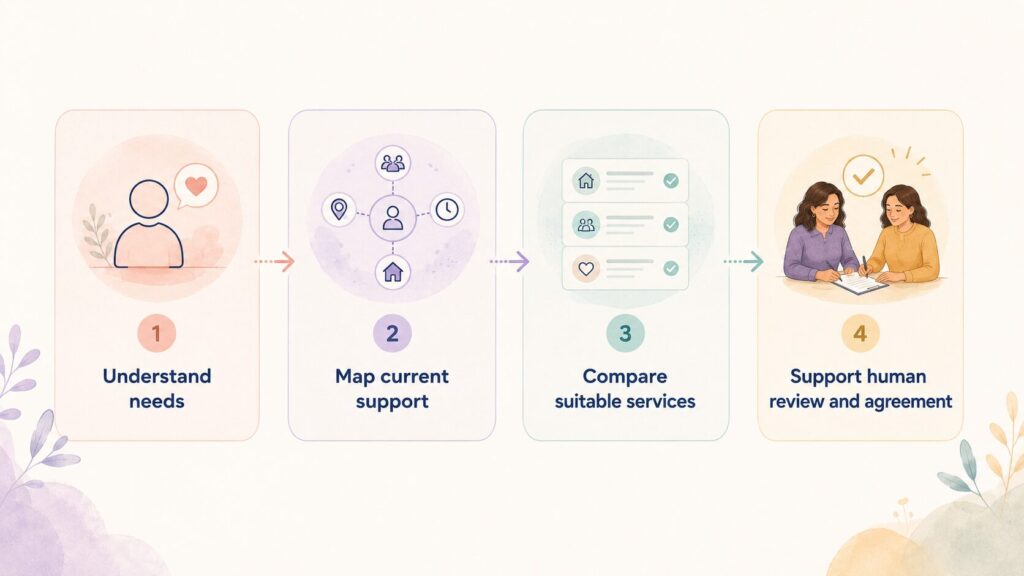
Waypaths is designed to structure what a learner needs, what support is already in place, what individual services actually provide, what evidence has been supplied and where each request or decision has reached.
Gaps, service differences and practical constraints become easier to understand together. People remain responsible for every decision and agreement.
Waypaths was created in response to problems encountered repeatedly across education, SEND and alternative provision: important learner needs buried in long documents, provider offers described in broad paragraphs, current support difficult to see as one picture, and suitability, availability and decision reasoning held in different places.
Providers, alternative provisions and specialists can spend significant time reading long plans and reports before they can establish whether a learner may be appropriate for a particular service. Teams on every side may have to extract the same needs from the same long documents before they can compare support clearly.
Providers may also be asked to submit similar policies and evidence to several local authorities, trusts or other referring organisations, each using different formats and review requirements. Documents, decisions and later updates can then become spread across email threads, staff handovers and separate records. This administration carries real cost and takes time away from direct support. Lost context and delayed reviews can also contribute to learners waiting longer for a clear decision.
On this page.
The model in one view.
Each stage of the Waypaths model responds to a problem practitioners repeatedly have to work around. The aim is not simply to produce one overall match. It is to identify one or more potentially relevant services or combinations, show the reasoning and constraints clearly, and support decision-makers to choose an appropriate option for the learner within the circumstances they are working in.
- Confirm the learner’s specific needs and essential requirements.
- Record the services and support already in place.
- Bring potentially relevant internal and external services into the same service-level view.
- Apply eligibility, essential-requirement, suitability and feasibility checks.
- Review provider compliance evidence and the status recorded by the named commissioning or referring organisation.
- Compare how one service or a combination of services may meet the needs.
- Prepare and track an access or referral request.
- Keep the response, amendments and human agreement visible.
- Coordinate and review the agreed support as circumstances change.
Evidence, permissions and information-sharing conditions apply throughout the process. They do not turn uncertainty into certainty, and they do not make the final decision.
Build a human-confirmed needs picture.
The problem
A diagnosis is not a needs profile. Two autistic learners may share a diagnosis and have very different communication, sensory, regulation, learning, environmental and access needs.
EHCPs, equivalent plans, assessments and reports can contain essential information, but the detail may sit across long narrative sections and several documents.
School teams, commissioners, providers and specialists can all spend time extracting the same needs before they can establish whether a service may be relevant.
The Waypaths approach
Relevant information may come from existing plans, assessments, reports, professional observations, learner voice, family knowledge and current support records. Only necessary and permitted information should be used.
Waypaths is designed to structure that information into a clearer needs profile. A person then checks what is current, accurate and safe to use before matching begins.
The profile should distinguish:
- strengths, priorities and barriers;
- specific support and access requirements;
- essential conditions that must be met;
- preferences that may improve fit but are not absolute requirements;
- current support and what it is intended to address;
- information that is confirmed, reported, assessed, inferred or still unclear;
- the reason support is being explored.
Start with what is already around the learner.
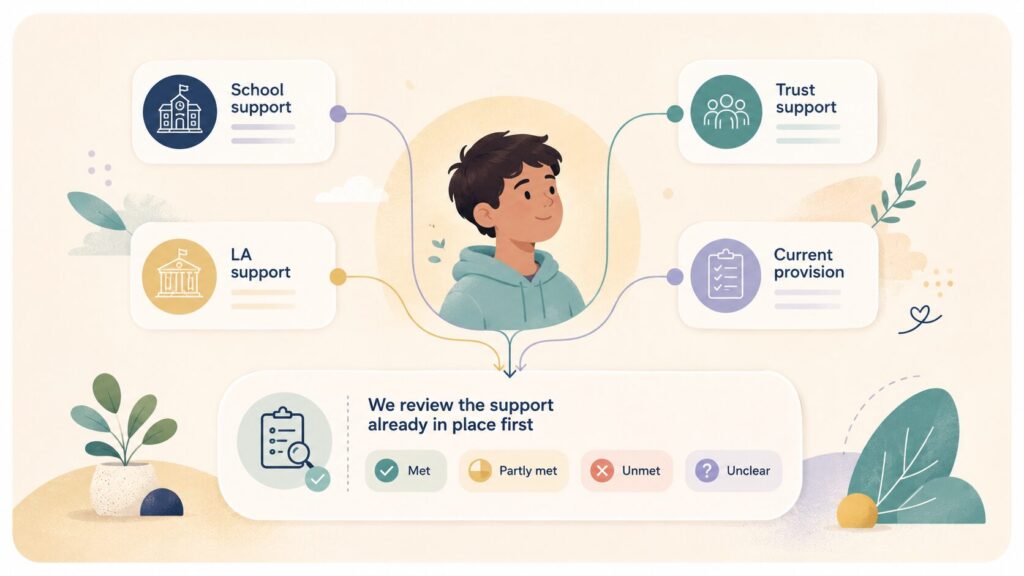
The next step is not always to find an external service.
A school may already have relevant support. A trust may hold specialist capacity elsewhere in its network. A local authority may have services that are difficult to see alongside commissioned provision.
Waypaths is designed to map that current support first. Teams can then see which needs appear to be met, partly met, unmet or unclear, and decide what may need to be explored next.
Internal and external services use the same core model. Who delivers a service does not determine whether it is suitable.
See current and possible services in one service-level view.
The problem
Knowing that support exists is not the same as knowing which needs it meets. Current support can be spread across timetables, provision maps, intervention records, plans, invoices, meeting notes and the knowledge of individual staff.
Knowing a provider’s name is also not the same as knowing what it provides. The detail may be spread across web pages, brochures, proposals and long paragraphs that blend several programmes into one broad description.
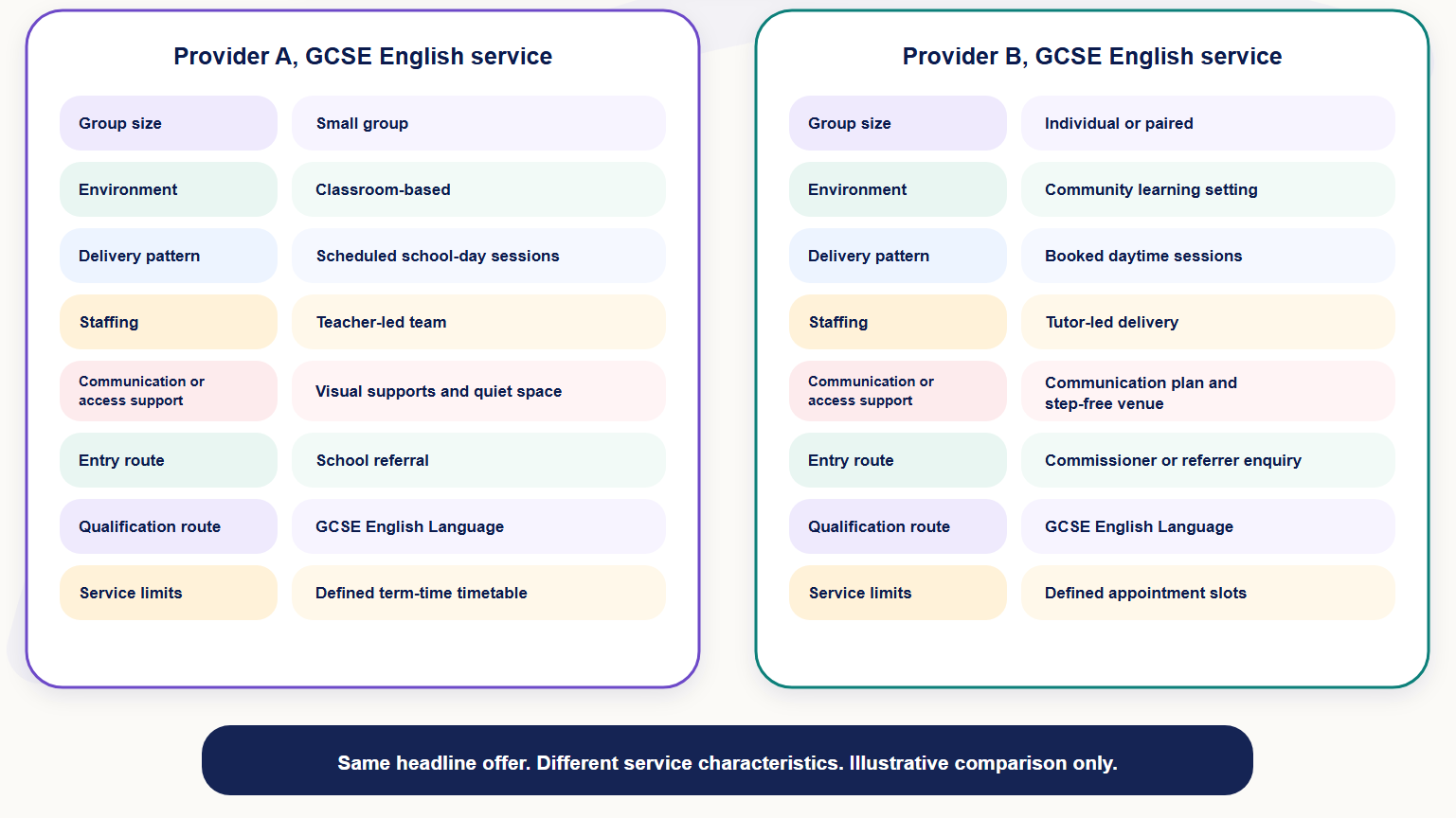
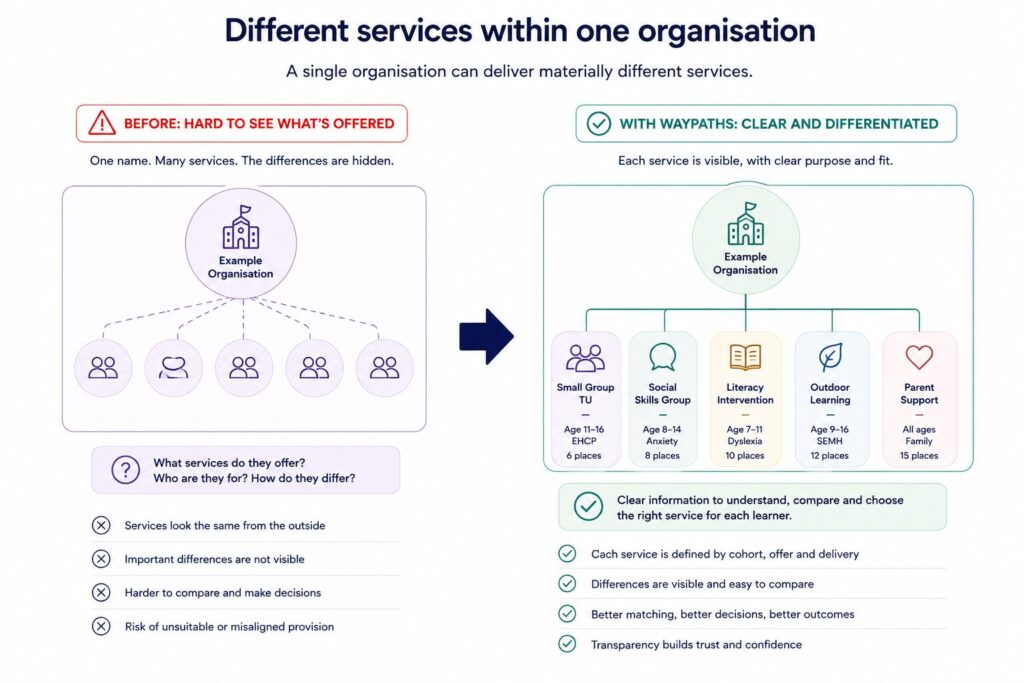
Two services may both offer equine work or GCSE English, but the shared label does not show whether they use the same group size, environment, staffing, teaching approach, therapeutic model, timetable, access conditions or support methods. Those differences affect which needs each service may be able to meet.
The Waypaths approach
Waypaths is designed to bring current and potentially relevant services into the same consistent service structure, whether they are delivered internally or externally.
Current services are recorded first and linked to the needs they appear to address. This helps prevent support already in place from being presented again as though it were a new option. The remaining needs picture should show what appears met, partly met, unmet or unclear.
Other potentially relevant services can then be considered alongside the current support. Internal versus external is a service characteristic, not the starting assumption or the final answer. Wider services are explored only where they may be relevant, followed by human review of what should happen next.
Each individual service or service variant can describe:
- the needs it is designed to support;
- age or stage range;
- delivery model and timetable pattern;
- environment, group size and staffing;
- communication, accessibility and essential requirements;
- specialist input, curriculum or qualification route;
- entry criteria, location, access route and service limits;
- current capacity or other feasibility information where confirmed.
Where an internal service appears to address a need currently supported externally, or an external service may add something not available internally, both can remain visible for human comparison. Funding or cost may form part of the feasibility information, but they do not determine on their own whether the internal, external or lower-cost option is better for the learner.
Two illustrative services share the headline label GCSE English but differ in group size, environment, delivery pattern, staffing, communication or access support, entry route and service limits. Waypaths is designed to compare those individual service characteristics rather than assume that the same provider category, activity or qualification label means the services meet needs in the same way.
Apply matching checks in visible layers.
One overall match can hide the reasons that matter. A service may look strong across several areas but fail one essential requirement. It may appear suitable but be impossible to access now. Another option may be available and familiar while being a weak fit for the identified needs.
Waypaths is designed to apply matching checks in distinct layers. The layers inform one another, but their reasoning remains separately visible.
Layer 1: Eligibility
Establish whether the service can be considered for the learner and the current purpose. This may include age or stage range, referral route, entry criteria, commissioning scope and other basic conditions.
Layer 2: Essential requirements
Keep non-negotiable needs visible. If a confirmed essential requirement is not met, the service should not be presented as an uncomplicated match. If the information is missing, the status should be unknown or needs checking, not a pass or failure.
Layer 3: Suitability
Show how the service characteristics appear to align with the learner’s confirmed needs. This may include environment, sensory characteristics, staffing, group size, delivery model, communication support, specialist input, preferences and contribution alongside current support.
Layer 4: Feasibility
Show whether the service can realistically be accessed in the current circumstances. This may include capacity, start date, location, transport, timetable, referral route, funding route, decision authority and information still required.
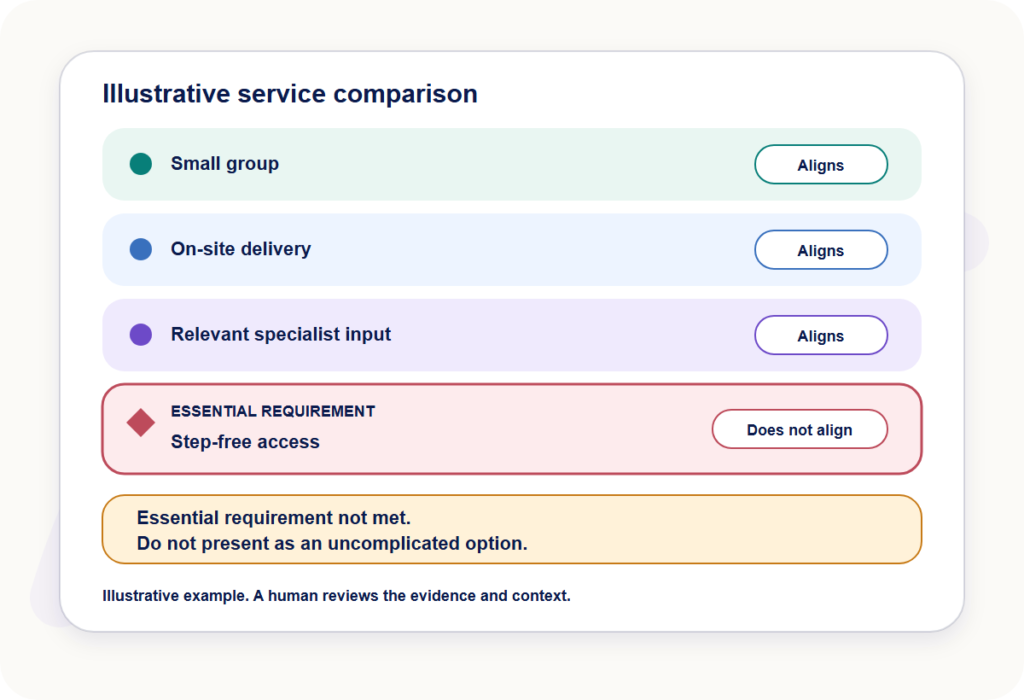
In this illustrative example, a service aligns with several characteristics but does not provide required step-free access. Because step-free access is an essential requirement, it remains visible and the service is not presented as an uncomplicated option. The result is not calculated by averaging the requirement against the other areas of alignment.
Suitability asks whether the service appears to align with the confirmed needs, essential conditions and access requirements. Feasibility asks whether it can actually be accessed given capacity, timing, location, transport, referral, funding and any information still to be checked. Both questions inform human review. Neither question makes the decision.
See the compliance evidence and the named organisation’s review status.
The problem
Alternative provisions, specialists and other service providers can be asked to submit similar policies, evidence and service information to every local authority, trust or other organisation that may refer or commission support.
The core requirements often overlap, but the requests may arrive through different forms, spreadsheets, portals and email threads. Different organisations may require different additional items. Providers then have to monitor expiry dates, respond to follow-up questions and send updated documents to several places. For a small provider, that repeated work can take substantial time and carry real administrative cost.
On the other side, commissioning and referring teams still need to know what has been supplied, what is current, what their own organisation has reviewed, what conditions apply and what must happen before the service can be used.
The Waypaths approach
Waypaths is designed to provide one structured evidence bank for reusable core provider information, alongside the additional requirements and human review status of each named organisation.
Providers can maintain core evidence and see what is missing, expired or due for review. Each commissioning or referring organisation can review the relevant evidence, request further information and record its own decision, scope, conditions and review date.
Waypaths does not decide whether a provider is universally compliant, safe or approved. One organisation’s approval does not automatically apply to another organisation or every service delivered by the provider.
Where a service appears to be a strong needs match but has not yet been reviewed by the relevant organisation, it can remain visible as potentially relevant, organisation review required. The next due-diligence step should be clear rather than the service silently disappearing from consideration.
Where the named organisation requires approval before a service can be used, the option cannot progress as currently feasible until that process is completed. The suitability reasoning can remain visible while the organisation-specific review acts as a practical access block.
A provider evidence bank can hold reusable core organisation and service information with supplied, missing, expired and review-due statuses. Each named commissioning or referring organisation can add its own requirements and record whether review has not started, is in progress, needs further information or has resulted in an organisation-specific approval for a defined service, scope, date and review point. Waypaths does not issue one universal compliance approval, and one organisation’s decision does not automatically apply to another.
Compare one service or a combination of services against the needs.
The problem
One service should not be expected to meet every need. Provision decisions can be framed as though one new placement or service must solve everything. That can hide the support already working, duplicate a service the learner already receives, create unrealistic expectations of one provider and make the exact remaining gaps harder to name.
The Waypaths approach
Waypaths is designed to show how current, internal and external services may work individually or in combination around the learner’s specific needs. Waypaths makes possible combinations and their reasoning easier for the relevant people to compare and decide.
The comparison should make clear:
- which needs current support appears to meet;
- which needs may be better met by changing or replacing part of the current support;
- which remaining needs one possible service may address;
- how two or more services may contribute without duplicating one another;
- where support overlaps;
- which needs remain partly met, unmet or unclear;
- what eligibility, evidence or feasibility questions remain open;
- what the funding and delivery implications are for human consideration.
Keep the request, response and agreement visible.
A potentially relevant service or support combination creates the basis for an access or referral request. The request, necessary and permitted supporting information, questions, responses, amendments and decision history are designed to remain visible to the people with permission to see them.
The service owner or provider reviews the available information, including fit, capacity, risks, adjustments, delivery requirements and proposed outcomes. They may:
- accept the request;
- decline the request;
- ask for more information;
- propose an amendment.
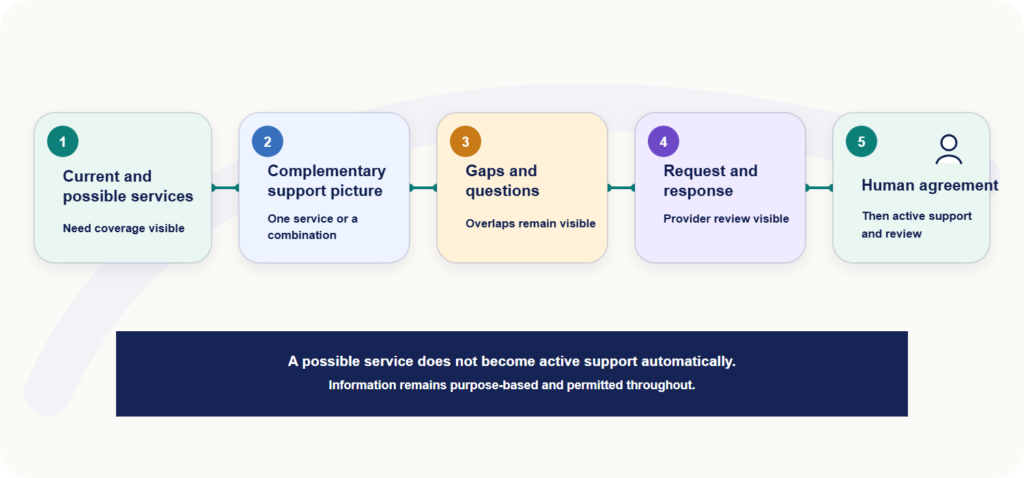
Provision becomes active only when the relevant people and organisations agree. A visible status does not replace direct professional communication where it is needed. Statutory duties, safeguarding processes, professional judgement and legal responsibilities remain with the people and organisations that hold them.
Keep the support picture current and improve.
Once support is agreed, Waypaths is designed to help keep the active provision package, responsibilities, review dates, decisions and changes easier to understand.
Outcomes are proposed, negotiated and agreed by the relevant people. Waypaths can help record and review them; it does not prescribe them.
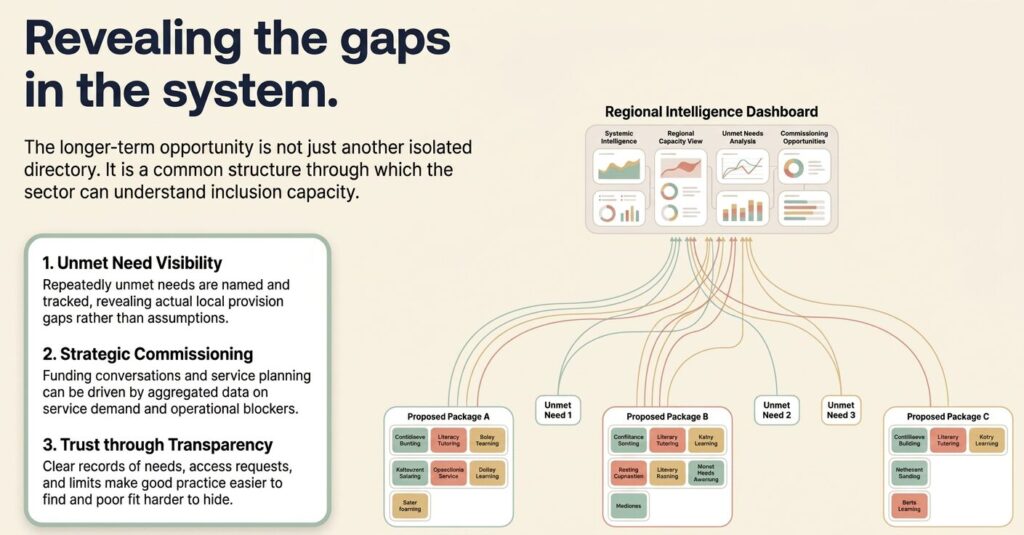
Over time, appropriately permissioned and de-identified information may help teams investigate recurring unmet needs, capacity gaps, access barriers and service demand. These patterns support human learning and planning. They do not make decisions on their own.
Built-in boundaries and frequently asked questions.
Does Waypaths choose a placement?
No. Waypaths supports structured comparison, access requests and clearer decision records. It does not automatically place learners or replace the people responsible for the decision.
Does Waypaths choose the best service or combination?
No. Waypaths is designed to show potentially relevant services or combinations, the needs they may meet, the matching layers, open questions and practical constraints. The relevant people compare the options and decide what is appropriate within the circumstances.
Is Waypaths only for alternative provision?
No. Alternative provision is an important part of the initial context, but the model can also represent internal school support, trust services, local authority services and independent specialist support.
Does Waypaths certify providers?
No. Waypaths can show service information, supplied evidence, missing items, expiry and review status. It can also show the decision recorded by a named organisation for a defined scope and date. Each organisation remains responsible for its own checks and approval decisions, and one organisation’s approval does not automatically apply to another.
Does ‘not yet reviewed’ mean that a service cannot be considered?
Not necessarily. A service may remain visible as potentially relevant while the named organisation’s evidence review or approval process is completed. If that organisation requires approval before use, the service cannot progress as a currently feasible option until the review is complete. Missing evidence and open review steps should remain clear. They are not the same as a finding that the service is unsafe or unsuitable.
Does Waypaths diagnose learners or write outcomes?
No. Needs and outcomes are confirmed, proposed and agreed by the relevant people and professionals. Waypaths helps structure and record information.
Is Waypaths a safeguarding reporting route?
No. Safeguarding concerns must follow the usual safeguarding or emergency route. General comments and research forms must not be presented as monitored safeguarding channels.
Does everyone see the full learner record?
No. Waypaths is designed around role and permission-based access to necessary information. Providers should receive only what they need to assess a request, and information should be reviewed before it is shared.
Does every unmet need lead to an external service?
No. Waypaths starts by mapping support already in place. The next step may be to adjust, coordinate or clarify existing support before exploring something additional.
See what the model means for your part of the system.
Local Authorities
Explore service visibility, unmet gaps, evidence status, practical blockers and clearer decision records.
Schools
Explore current support mapping, unmet needs and clearer next steps before an external search becomes the default.
Multi-Academy Trusts
Explore trust-wide services, shared specialist capacity and recurring provision gaps.
Alternative Provision
Explore service-level profiles, honest service limits, reusable evidence and clearer access requests.
Specialists
Explore how specialist requirements and services can sit within the same support picture.
Families and Guardians
See how needs, support, gaps and decisions are intended to become clearer where organisations use Waypaths and access is permitted.
What would you like to do next?
See Waypaths for your organisation
Choose the perspective closest to your role and the questions you need to answer.
Register interest
Tell us what you are interested in and whether there may be a useful fit.
Share your experience
Contribute lived or professional experience to the research shaping Waypaths.
Registering interest does not commit an organisation to a pilot or paid service. Research participants should not include identifiable learner information.